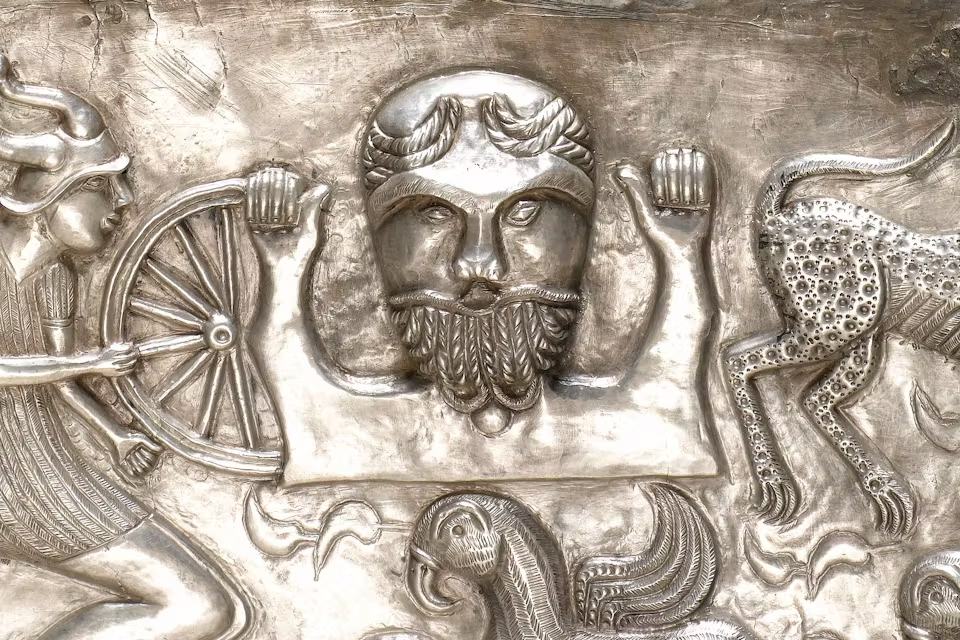
Taranis, a god of thunder, was one of the most important gods among the Celts of Iron Age Europe. There is evidence of his worship in Gaul, Hispania, Britain, and Ireland, as well as in the more Germanic Rhineland and Danube regions.
Placing a god of thunder at the center of their pantheon seems to link Celtic religious practices with those of the Norsemen and Germans, who worshipped Thor as one of their principal deities, and Slavic people, who worshipped Perun as a god of thunder and war. The Finns also had a related sky and thunder god called Ukko.
Taranis seems more closely associated with these thunder gods than with Zeus or Jupiter worshipped in the Greco-Roman world. However, the Romans did syncretize Taranis with their own lightning-wielding deity Jupiter. The Greeks also associated him with the Cyclops Brontes, whose name means thunder.
Images of Taranis

Images of Taranis survive from throughout the Celtic world, and he is usually depicted as a man with a beard holding a thunderbolt in one hand and a wheel in the other. The famous example above was found in Haute-Marne in France (Gaul).
Taranis was closely associated with the wheel, and specifically the six-spoked chariot wheel. This may suggest that he was also associated with war, as the Romans noted that while the Celts were “barbaric” in their opinion, they rode into war in sophisticated chariots.
Taranis also seems to appear on the Gundestrup Cauldron (depicted above), a Celtic piece probably made in sometime in the 1st century BCE and found in Denmark. The bearded figure with the wheel is surely Taranis.
This chariot wheel appears often in Celtic art, on coins and often worn as pendants that seem to have been worn frequently in the Bronze Age. This draws another striking parallel with the Norse god Thor, as the Vikings wore Thor’s hammer or Mjolnir pendants as symbols of identity and protection.

Taranis wheels, also often called sun wheels, were often offered as votive offerings in sacred spaces in the Celtic world. The above are a few examples of the thousands of wheels that have been found at Celtic sacred sites.

Taranis was frequently alluded to on Celtic coinage. The coin above from 2nd century BCE Celtic Hungary shows a stallion with the wheel of Taranis above.

The coin above was minted by the Aedui tribe in Gaul c. 80-50 BCE. Already influenced by the Roman Empire, it shows the goddess Roma on the obverse and a prancing stallion with the wheel of Taranis on the reverse.

The above Balkan Celtic coin from 1st century BCE Bulgaria shows a larger-than-life man with the wheel of Taranis by his side, possibly as an identifier.

The above coin from Belgic Gaul dating to the 1st century BCE shows the same rearing stallion with a V image above it on the obverse. The same V image seems to be replicated with more details on the reverse, showing the same crossing lines as on the previous coin, and the wheel of Taranis. Stars are one clear element, suggesting an association with the sky.
Human Sacrifice
The first century CE Roman author Lucan claims in his Pharsalia that Taranis was one of several Celtic gods who received human sacrifices. He says that three Celtic gods received these kinds of bloody sacrifices from long-haired Celts led by Druid priests, Esus (lord or master), Toutatis (god of people), and Taranis (the thundered).
An unnamed 4th century commentator on Lucan’s text says that sacrifices for Esus were hung from a tree, just like human sacrifices to the Norse god Odin. He says that sacrifices to Toutatis were drowned. Many Iron Age people were known to place sacrifices to the gods in bodies of water such as bog to transport them to the divine. Finally, sacrifices to Taranis were burned.

In an act of syncretism, Esus is identified with Mercury, as was the Germanic god Odin, and Teutates was identified with Mars, as was the Norse god Tyr. Taranis seems to have been identified with Jupiter and sometimes called a “master of war”. The above Roman era statue shows Taranis syncretized with Jupiter, with the eagle of Jupiter and the solar wheel of Taranis.
Scholars also suggest that Taranis may be the unidentified god that both Julius Caesar and the Greek geographer Strabo describe as receiving human sacrifices burned alive in wicker men.
It is unclear whether the Roman author was repeating cliches about the Barbarian Celts that were circulating at the time, or whether his claims were based on Roman eye-witness testimony.
Who Was Taranis?

Because the Celts did not write about themselves, we know very little about their ideology and beliefs. We only have fragmentary texts, like the above bone fragment from Italy, dating to the 4th or 3rd century BCE, with the name Taranis written in a Celto-Etruscan script.
Nevertheless, Taranis seems to have been a god of Thunder akin to Thor or Perun, which suggests that he was associated with storms and fertility but was also considered a formidable warrior. This is further supported by his association with the chariot wheel, since the Celts rode chariots into battle.
Taranis was certainly an important Celtic god, as the evidence suggests that he was worshipped widely throughout the Celtic world. This contrasts with many Celtic gods that were associated with specific places, such as rivers or groves.
Leave a Reply