
In 2026, Chinese New Year will take place between 17 February and 3 March as we welcome the year of the Fire Horse.
But what is the tradition behind Chinese New Year, how is it calculated, what are the traditions of the two-week festivals, and what are the meanings of the different animals that characterize the year?
When is Chinese New Year
Chinese New Year marks the end of winter and the beginning of spring, so it falls on the second new moon after the winter solstice around 21 December. Therefore, it will always start sometime between 21 January and 20 February. That is considered the first day of the year.
In Western countries, this is often called the Lunar New Year, but China actually uses a lunisolar calendar, which combines lunar cycles within the solar year so that the seasons do not fall out of sync. This means that every year has 12 lunar months, and every 2-3 years there is a 13th intercalary month of 13 days to maintain sync with the solar cycle. This calendar has been used in China for at least 3,000 years, though it has been refined over time to increase accuracy.
The festival starts on the evening before the day of the new moon, and finishes with a lantern festival on the 15th day of the year, which is the first full moon of the year.

The Festivities
The Chinese New Year festival is held from the day before new year to the 15th day of the year, with different activities for each day.
- New Year’s Eve: clean the house to drive out negative energy and gather for a family reunion dinner. It is traditional to stay up late to welcome in the new year and scare off the Nian (see below).
- Day 1: Honor the ancestors of the family, usually wearing new, often red, clothes and visiting the oldest living family members. This is not a day for cleaning, as you could clean away the good luck of the new year.
- Day 2: Married daughters visit their birth parents. It is also known as the day of dogs, and dogs are often given special treats.
- Day 3: This is considered an unlucky day for socializing so it is usually a day of rest.
- Day 4: Families burn incense and offer food to welcome the Kitchen God back from heaven, where he has been reporting on the family’s behavior to the Jade Emperor (the supreme ruler of heaven).
- Day 5: As the birthday of the god of wealth, people set off firecrackers to get his attention and traditionally eat dumplings, which look like gold ingots, to summon prosperity. The taboo on sweeping ends today.
- Day 6: Families throw away unwanted items to drive away poverty and have a fresh start to the year.
- Day 7: According to myth, this is the day humans are created, so everyone gets a day older and eats longevity noodles or a special seven-vegetable soup.
- Day 8: Preparations for the birthday of the Jade Emperor, usually with a small family dinner.
- Day 9: Elaborate celebrations for the birthday of the Jade Emperor, including offerings of fruit, tea, and roasted meats.
- Days 10-12: Days for consuming leftovers with family and friends.
- Day 13: Cleanse the body after two weeks of feasting with light vegetarian meals and start preparing lanterns.
- Day 14: Build lanterns and practice dragon and lion dances.
- Day 15: The Lantern Festival on the first full moon of the year, where lanterns with wishes are let fly.
The Myth of Nian
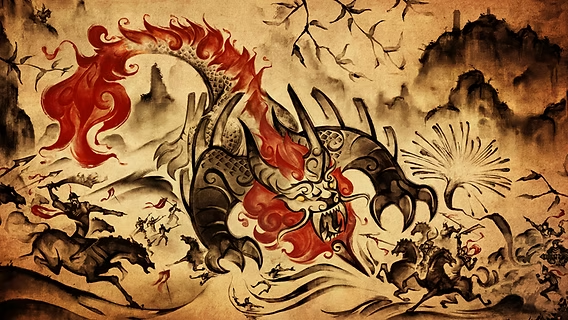
According to legend, an underwater beast that looks like a lion with horns, called a Nian, was terrorizing villages during the spring festival, eating children in the middle of the night. One year, all the villagers hid from the Nian, except for one old man who said that he would get revenge on it for the community. That night, he put up red paper and set off firecrackers, scaring the Nian away. When the villagers returned, they saw that nothing had been destroyed.
From that day, they understood that the Nian was afraid of the color red and the sound of crackers, which gave birth to the new year traditions to keep the Nian away.
Historically, the celebration of Chinese New Year can be traced back to the Warring States period (475-221 BCE), when an exorcism of disease was celebrated on the last day of the year. This evolved into the practice of cleaning one’s house thoroughly, ready for the new year. Not long after, during the Han Dynasty (202 BCE to 220 CE) there are records of families worshipping their ancestors on the first day of the year. From there, it grew into the larger festival known today.
Years and the Chinese Zodiac
While we tend to pay attention to the animal associated with the Chinese year, this is just one aspect of how the year is defined.
Defining the year depends on the Sexagenary Cycle (Ganzhi), which is a cycle of 60 terms. It combines five Heavenly Stems, represented by elements, with twelve Earthly Branches, represented by animals.
So, the first year in the cycle (jiazi) combines the first Heavenly Stem with the first Earthly Branch, and then the second year (yichou) combines the second Heavenly Stem with the second Earthly Branch. This continues until the cycle concludes with the last year (guihai) at 60. Each Heavenly Stem has two names for the same element, so, for example, both year one and year two are wood elements. The first year is considered a yang year, and the second a yin year.

The same system is then used to characterize the months, days, and even the hours, giving each a unique character.
This is an ancient system that appears as far back in time as the 2nd millennium BCE, and it was used to record years officially from at least the 3rd century BCE.
Tracking the Years
| Year Number | Heavenly Stem | Earthly Branch | Yin and Yang | Years |
| 1 | Wood | Rat | Yang | 1984, 1924 |
| 2 | Wood | Ox | Yin | 1985, 1925 |
| 3 | Fire | Tiger | Yang | 1986, 1926 |
| 4 | Fire | Rabbit | Ying | 1987, 1927 |
| 5 | Earth | Dragon | Yang | 1988, 1928 |
| 6 | Earth | Snake | Yin | 1989, 1929 |
| 7 | Metal | Horse | Yang | 1990, 1930 |
| 8 | Metal | Goat | Yin | 1991, 1931 |
| 9 | Water | Monkey | Yang | 1992, 1932 |
| 10 | Water | Rooster | Yin | 1993, 1933 |
| 11 | Wood | Dog | Yang | 1994, 1934 |
| 12 | Wood | Pig | Yin | 1995, 1935 |
| 13 | Fire | Rat | Yang | 1996, 1936 |
| 14 | Fire | Ox | Yin | 1997, 1937 |
| 15 | Earth | Tiger | Yang | 1998, 1938 |
| 16 | Earth | Rabbit | Yin | 1999, 1939 |
| 17 | Metal | Dragon | Yang | 2000, 1940 |
| 18 | Metal | Snake | Yin | 2001, 1941 |
| 19 | Water | Horse | Yang | 2002, 1942 |
| 20 | Water | Goat | Yin | 2003, 1943 |
| 21 | Wood | Monkey | Yang | 2004, 1944 |
| 22 | Wood | Rooster | Yin | 2005, 1945 |
| 23 | Fire | Dog | Yang | 2006, 1946 |
| 24 | Fire | Pig | Yin | 2007, 1947 |
| 25 | Earth | Rat | Yang | 2008, 1948 |
| 26 | Earth | Ox | Yin | 2009, 1949 |
| 27 | Metal | Tiger | Yang | 2010, 1950 |
| 28 | Metal | Rabbit | Yin | 2011, 1951 |
| 29 | Water | Dragon | Yang | 2012, 1952 |
| 30 | Water | Snake | Yin | 2013, 1953 |
| 31 | Wood | Horse | Yang | 2014, 1954 |
| 32 | Wood | Goat | Yin | 2015, 1955 |
| 33 | Fire | Monkey | Yang | 2016, 1956 |
| 34 | Fire | Rooster | Yin | 2017, 1957 |
| 35 | Earth | Dog | Yang | 2018, 1958 |
| 36 | Earth | Pig | Yin | 2019, 1959 |
| 37 | Metal | Rat | Yang | 2020, 1960 |
| 38 | Metal | Ox | Yin | 2021, 1961 |
| 39 | Water | Tiger | Yang | 2022, 1962 |
| 40 | Water | Rabbit | Yin | 2023, 1963 |
| 41 | Wood | Dragon | Yang | 2024, 1964 |
| 42 | Wood | Snake | Yin | 2025, 1965 |
| 43 | Fire | Horse | Yang | 2026, 1966 |
| 44 | Fire | Goat | Yin | 2027, 1967 |
| 45 | Earth | Monkey | Yang | 2028, 1968 |
| 46 | Earth | Rooster | Yin | 2029, 1969 |
| 47 | Metal | Dog | Yang | 2030, 1970 |
| 48 | Metal | Pig | Yin | 2031, 1971 |
| 49 | Water | Rat | Yang | 2032, 1972 |
| 50 | Water | Ox | Yin | 2033, 1973 |
| 51 | Woo | Tiger | Yang | 2034, 1974 |
| 52 | Wood | Rabbit | Yin | 2035, 1975 |
| 53 | Fire | Dragon | Yang | 2036, 1976 |
| 54 | Fire | Snake | Yin | 2037, 1977 |
| 55 | Earth | Horse | Yang | 2038, 1978 |
| 56 | Earth | Goat | Yin | 2039, 1979 |
| 57 | Metal | Monkey | Yang | 2040, 1980 |
| 58 | Metal | Rooster | Yin | 2041, 1981 |
| 59 | Water | Dog | Yang | 2042, 1982 |
| 60 | Water | Pig | Yin | 2043, 1983 |
Animal Meanings

The animals that characterize each year are believed to have different traits that characterize their year, and sometimes people born in that year.
| Animal | Years | Traits |
| Rat | 1948, 1960, 1972, 1984, 1996, 2008, 2020, 2032 | Rats are ambitious but honest. They are prone to seeking pleasure, which means that both money and relationships rarely last. |
| Ox | 1949, 1961, 1973, 1985, 1997, 2009, 2021, 2033 | Oxen are intelligent and patient and tend to be an inspiration to others. They are often loners, but happy to be so. |
| Tiger | 1950, 1962, 1974, 1986, 1998, 2010, 2022, 2032 | Tigers are both aggressive and courageous, and sensitive conversationalists. They tend to be powerful leaders |
| Rabbit | 1951, 1963, 1975, 1987, 1999, 2011, 2023, 2035 | Considered lucky, rabbits are talented and articulate, and while they are shy, they are also affectionate. They tend to be conflict-averse. |
| Dragon | 1952, 1964, 1976, 1988, 2000, 2012, 2024, 2036 | Dragons are strong and independent who feel like they don’t need anyone, but love validation. They are often eccentric and have excellent health. |
| Snake 19 | 1953, 1965, 1977, 1989, 2001, 2013, 2025, 2037 | Snakes are wise and intense and tend to be very attractive. They do tend to be vain and have a fiery temper. |
| Horse | 1954, 1966, 1978, 1990, 2002, 2014, 2026, 2038 | Horses tend to be popular and considered attractive by others. They are lively and warm-hearted and don’t like to be alone. |
| Goat | 1955, 1957, 1979, 1991, 2003, 2015, 2027, 2039 | Goats are considered timid and don’t like to be the center of attention. They are elegant and creative, but are naturally insecure. |
| Monkey | 1956, 1968, 1980, 1992, 2004, 2016, 2028, 2040 | Considered both intelligent and mischievous, they tend to be influencers and at the center of things. They often have a short attention span and quit when the going gets tough. |
| Rooster | 1957, 1969, 1981, 1993, 2005, 2017, 2029, 2041 | Roosters tend to be pioneers and hard workers with a thirst for knowledge. They can be selfish and tend to be blessed with charisma. |
| Dog | 1958, 1970, 1982, 1994, 2006, 2018, 2030, 2042 | Dogs work well with others and enjoy adventures, but can have a tendency to do the minimum required. They often have a good sense of humor. |
| Pig | 1959, 1971, 1983, 1995, 2007, 2019, 2031, 2043 | The pig is a symbol of luck and wealth. They make good friends but bad marital partners despite, their genuine warmth. |
Leave a Reply