
The ancient Egyptians envisioned the sky as the goddess Nut, arching over the earth below, her nude body covered in stars. She was one of the gods of the Enneas of Heliopolis and was the great mother in their creation myth.
Nut is an enigma in mythology, in which the mother is usually the earth and the father the sky.
Heliopolitan Creation Myth

Egyptian religion was a collection of different gods and mythologies from different regions, brought together when the land united under the leadership of the pharaohs. This meant that many conflicting and alternative stories existed about things like creation, and there is no clear “canon.”
Nevertheless, one of the most enduring creation myths came from the city of Iunu, a city that the Greeks called Heliopolis. According to this myth, in the beginning, there was nothing but the chaotic primordial waters of Nun. Eventually, the Benben mound emerged from those waters, and Atum was able to create himself. He was a sun god often associated with Ra as Atum-Ra.
Atum-Ra created Shu and Tefnut, air and moisture, and then, in turn, gave birth to Geb and Nut, the earth and sky. This brother sister pairing also became husband and wife, and Nut became pregnant. Shu had to separate the two to create space for life to form, and he still holds Nut aloft from Geb, creating the world.

Nut gave birth to Osiris, Isis, Seth, and Nephthys, who would rule this new in-between world. The story of Seth slaying Osiris to steal his leadership position, Isis bringing her husband back to impregnate herself, and then creating the underworld for Osiris to rule are among the most famous to survive from ancient Egypt.
Some versions of the myth suggest that Atum-Ra forbade Nut from giving birth during the official calendar year. The Egyptian calendar had 360 standard days divided into 12 months of 30 days. Nut reportedly asked Thoth, the god of the calendar, among other things, to help her, and he added five extra days to the year so that she could give birth to her five children, the fifth being Horus the Elder.
Mother and Protector

Nut was the personification of the sky. The Egyptians often described celestial bodies such as the sun and moon making their way across her body during the day, then at dusk, they were swallowed and passed through her belly to be reborn at dawn. The Milky Way was considered the celestial image of Nut.
As well as the mother of some of Egypt’s most important gods, she was also seen as the mother of the stars and other celestial bodies, which stay close to her in the sky. Amulets of Nut in her sow form were sometimes worn as fertility amulets.
It was sometimes said that her laughter was thunder, her tears caused rain, and her blood gave the sunrise and sunset their color.
Nut was seen as a great protector, as her body protected the world between the earth and the sky from whatever lay beyond. She is sometimes depicted with protective wings. She was sometimes worshipped as a healing goddess.
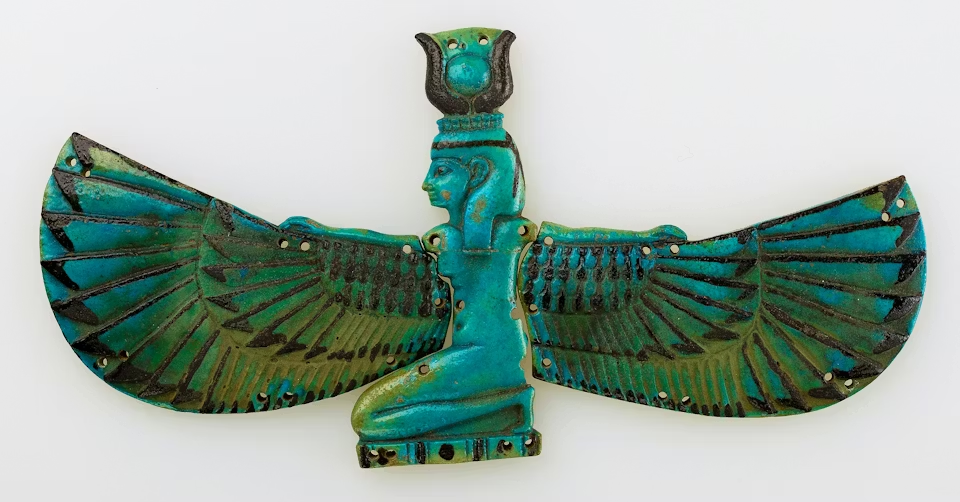
Since the Egyptians were very focused on the afterlife, she was also seen as a protector of those entering the underworld. She was often painted inside the lid of a sarcophagus as a protector. She was the great mother who gave life and accepted all spirits at death.
Nut is mentioned almost 100 times in the Pyramid texts, highlighting her importance in the funerary context. She is described as enfolding the body of the pharaoh, who asks to be placed among the stars that he might live for eternity.
Symbolism

Nut is usually depicted as a woman, often blue in color, whose naked body is covered in stars. She stretches over the earth, Geb, and his held up by the god Shu. She was sometimes depicted as a cow standing over the earth, her eyes representing the sun and moon, though Hathor was the most famous Egyptian cow goddess. She could also be a giant sow suckling piglets, which represented the stars.
She was also sometimes shown as a woman with a pot on her head, which was the hieroglyph for part of her name and also symbolized the uterus, as she was the great mother. But it also sometimes appears as a goddess with arms outstretched, accompanied by large protective wings. In this form, she often wore a headdress with a solar disk and horns.

The symbol of Nut was the ladder used by Osiris to enter the underworld, called maquet, which was often used in tombs to protect the deceased and guide them on their journey into the afterlife. She was also associated with the sycamore tree.
When writing about Egyptian mythology, the Greek writer Plutarch compared Nut with Rhea, the mother of the Olympian gods.
Book of Nut

Today, we call a collection of ancient Egyptian astronomical texts dating to around 2000 BCE the Book of Nut. It recorded the cycles of the stars through the Egyptian decans and tracked the movement of the sun, moon, and planets. The decans are 36 small star clusters that divide the elliptical sky into ten-degree sections. They rise consecutively on the horizon, acting as a kind of star clock.
Nine different copies of the book are known today, three inscribed on monuments – the tomb of Ramses IV, the cenotaph of Seti I at the Osireion at Abydos, and in the tomb of a noblewoman called Mutirdus from the 26th dynasty – and six on papyri found in a temple library at Tebtunis and dating to the 2nd century CE.
The monumental copies are clearly meant to show what the heavens looked like at a certain moment in time, suggesting that the Egyptians ascribed to the “as above, so below” theory, only further enhancing Nut’s importance.
Leave a Reply