
The Roman goddess Juno is considered the equivalent of the Greek goddess Hera, with many Roman deities borrowing Greek mythology. But Juno was much more in Rome than Hera was in Greece.
Juno Regina, alongside Jupiter Optimus Maximus and Minerva, was part of the Capitoline Triad. These were some of the most important deities in the Roman state religion and were responsible for the health and prosperity of Rome. Worship of the Capitoline Triad was also exported throughout the empire, making Juno an important international goddess. She was a goddess associated with sovereignty, fertility, and war.
Etruscan Origins

Juno was one of the first gods worshipped in Rome, imported to the new city established by Romulus – reportedly in the 8th century BCE though archaeology suggests that Rome was founded in the 6th century BCE – from the surrounding Italian communities.
A temple was built for her by the Etruscan king Lucius Tarquinius Priscus, the legendary 5th king of Rome. It is interesting that she is associated with the Etruscan king, rather than the second king Numa Pompilius, who is credited with establishing most of Rome’s religious traditions. The kings are largely legendary, so this represents a belief by later Romans of an Etruscan association.
In her Etruscan form, she was represented wearing a goatskin and carrying a spear and shield, giving her a warlike presence usually associated with Athena, whose Roman equivalent was Minerva. In Italy she was known as Uni, Juno Sospita (the savior), Juno Lucina (light of childbirth), and Juno Moneta (moon goddess). The Roman term for money is taken from this epithet of Juno.
Another story suggests that Juno was initially the patron of the Italian communities of the Veii, Ardea, and Lanuvium, but that her cult was transferred to Rome in 392 BCE by Furius Camillus after he conquered the Veii.
Greek Mythology
When the Romans encountered Hellenistic culture and started to soak it up, they began to associate many of their existing gods with the gods in Greek mythology. Juno was linked to Hera, and shares her mythology.
Where Hera was the daughter of Cronus and Rhea, Juno was the daughter of their Roman counterparts Saturn and Ops. She also married her husband Jupiter, the equivalent of Zeus, and had several children with him including Mars (Ares), Vulcan (Hephaestus), and Juventus (Hebe).
But while the stories of Hera focus on her jealousy and desire to get revenge on Zeus, his many lovers and illegitimate children, this did not become a major aspect of Juno. But Juno does feature as a villain or at least antagonist of Rome in some stories.
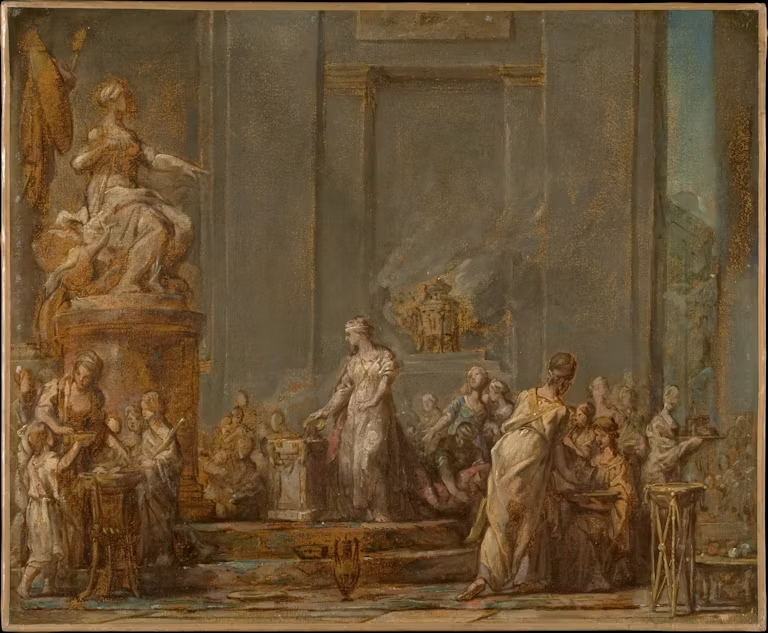
In Virgil’s Aeneid, the author describes Juno as favoring Carthage and wanting to sabotage the Trojan hero Aeneas’ destiny to create a new community in Italy so that Carthage can dominate the Mediterranean. She tries to deflect Aeneas in various ways, such as having him fall in love with the Carthaginian queen Dido. She also battered him with storms and turns the Italians against him. But with the help of his mother Venus/Aphrodite and other gods, Aeneas eventually makes it to Italy, and his descendant Romulus would establish the city of Rome.
Juno is also described as on the side of the Sabines under Romulus, when he and his men abducted many Sabine women as wives. She supported the Sabines as they attacked Rome in vengeance but relented when the Sabine women themselves intervened and asked their fathers and brothers to join with the Romans and create a new community.
Domains of Juno
Juno, as Juno Regina, is the queen of the Roman gods. While the Romans did not have kings and hated the institution after the expulsion of the kings, Rome was still a sovereign state. Jupiter and Juno represented that in many ways.
She was a champion of protector of women, a role that extended to every aspect of life. She protected women as they passed from the house of her father to her husband through marriage, protected them in childbirth, and helped them with their matronly duties. She had the epithets Juno Lucina for childbirth, Juno Iugalis for marriage and wedding rituals, and Juno Cinxia for the loosening of the girdle on the wedding night.
The Matronalia was one of the festivals dedicated to Juno, celebrated on March 1st. Traditionally a new year festival, it was a time of renewal and the awakening of nature. Because of her association with childbirth, Juno was naturally connected with ideas of fertility, renewal, and beginnings.
Juno was so closely associated with women that her name became the name for the guardian spirits that accompany each person. While men had a genius, women had a personal juno.
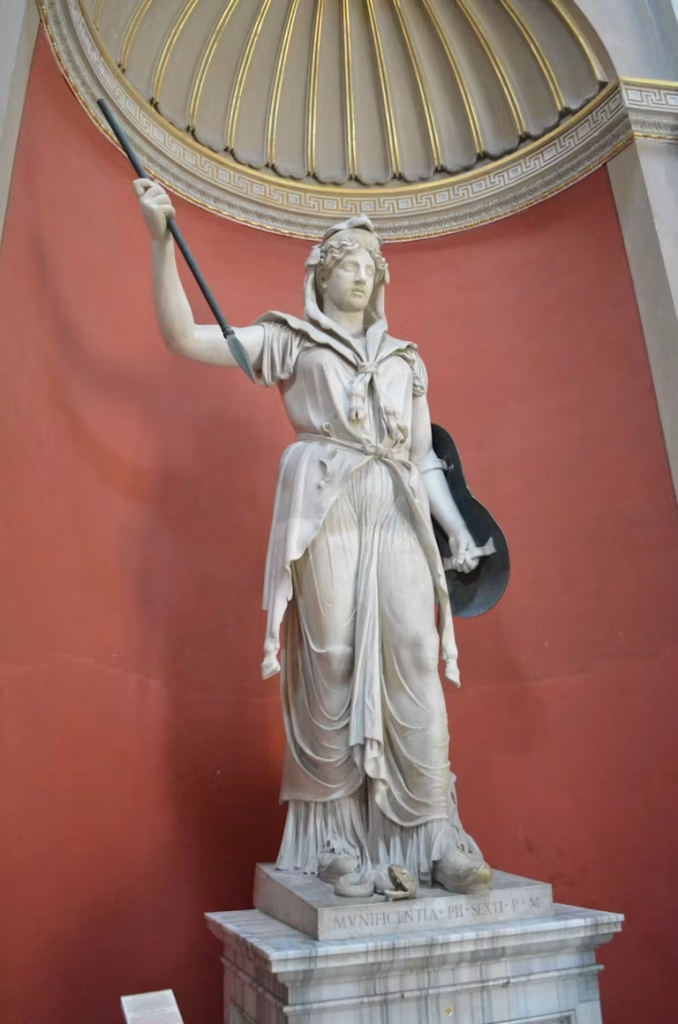
Juno was also associated with warlike aspects, sometimes seen with a horned goatskin, pointed shoes, and carrying a spear and shield. She was specifically the patron of adolescent male soldiers as Juno Sospita, the savior.
She was also seen as a goddess that could warn both individuals and the Roman state of oncoming danger. According to one story, it was her sacred geese that were kept in the Capitoline Hill the warned the Romans of the Gallic attack in 390 BCE.
Sanctuaries
Juno had several temples in Rome. The most important was on the Capitoline Hill in Rome alongside Jupiter and Minerva in the temple of Jupiter Optimus Maximus as the Capitoline Triad.
She also had a sanctuary encompassing a grove on the Esquiline Hill consecrated by the matrons of Rome in 375 BCE. To enter the temple women had to loosen their belt knots as these could interfere with childbirth, and pregnant women had to loosen their hair to pray.
She had a temple as Juno Moneta on the Arx of Rome consecrated in 344 BCE by Furius Camillus. She had another sanctuary in the Vicus Lugarius, a street leading to the Roman Forum, where she was worshipped as Juno Iugalis. There was a temple of Juno Sospita built in 194 BCE by the general C. Cornelius Cethegus in fulfilment of a vow in his war with the Insubres. Another temple to Juno Populona was for Juno who watched over the Roman people as they marched off to war. More temples were consecrated for Juno Regin by M. Aemilius Lepidus in 179 BCE and by Q. Caescilius Metellus Macedonicus in 146 BCE.
Worship
Juno was closely associated with new beginnings, and therefore received cult on the first day, the kalends, or every month alongside Janus, the god of beginnings. Jupiter was worshipped on the ides, the middle day, of each month.
Before every birth a coin was offered to Juno Lucina, and after the birth, a table with gifts for the goddess was set up in a private room and kept for a month.
The Matronalia was celebrated on the first of March. On this day, husbands would present gifts to their wives. This festival is thought to be linked with the abduction of the Sabine women and the gratitude that the men should show their wives for joining them.
The Nona Caprotina on July 7 was the feast of Juno Caprotina. It was a summer grain festival in which social norms were reversed.
She was also a goddess of the Lupercalia, a pastoral festival celebrated in mid-February. Priests known as the Luperci ran through the city whipping women with straps made from the skin of sacrificed goats. They were supposed to confer fertility on the women they touched.
Notably, she does not seem to have had any festivals in June, even though the month is named for her.
Capitoline Triad
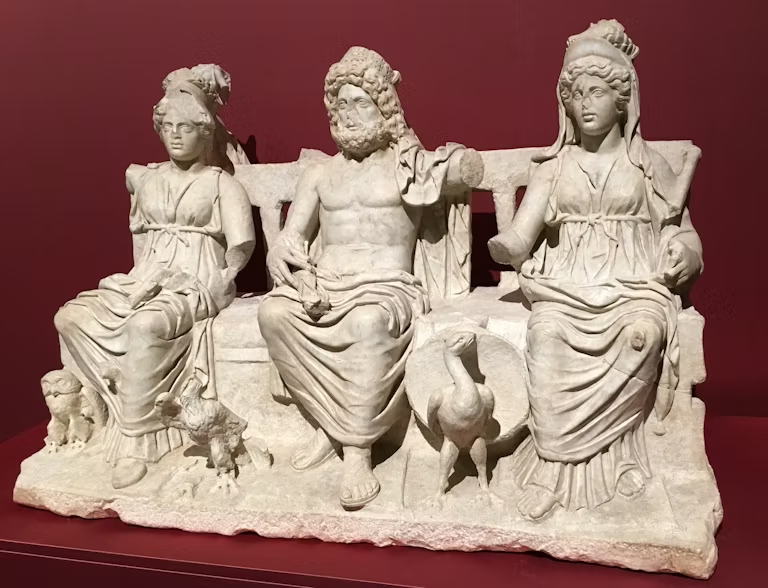
Juno’s most important role in Roman religion was as a member of the Capitoline Triad. The Romans believed that their state was uniquely favored by the gods, and that their favor needed to be maintained through proper worship of the gods. While many gods had to be appeased, which is why Rome was full of temples, the triad were the principal deities in terms of the prosperity of the Roman state.
The original Capitoline Triad seems to have been Jupiter, Mars, and Quirinus, but very early in Rome’s history they were replaced by Jupiter, Venus, and Minerva. Why is unclear. But the triad were worshipped together, and their principal temples was the Temple of Jupiter Optimus Maximus on the Capitoline Hill. While it is named for Jupiter, the temple had individual cella for each of the gods. Many important processions ended at the temple. For example, the observer Josephus recorded that the triumph of the emperors Vespasian and Titus for their suppression of the Jewish Revolt in 73 CE ended at the temple.
We get a glimpse of how important the Capitoline Triad was from the records of the Arval Brothers. These were a group of priests responsible for maintaining the cult of Dea Dia, but they also took on imperial cult duties when Rome became an empire.
The imperial cult recognized that the emperors were the center of the Roman state and that the prosperity of Rome depended on the prosperity of the emperor. Unlike the Greeks, the Romans did not believe in making sacrifices to men as though they were gods, so instead, they made sacrifices to the gods on behalf of the health, fortune, and success of the emperor.
The Arvals kept detailed records of all their sacrifices, and all started with the sacrifices of an ox to Jupiter Optimus Maximus, a cow to Juno Regina, and a cow to Minerva. Depending on the occasion, sacrifices might also be made to other deities such as imperial virtues, such as Victoria Augusta or Salus Augusta, and to the deified emperors such as Divus Augustus.
The fact that Jupiter, Juno, and Minerva always received the first sacrifices on behalf of the emperor shows that they were the main patron gods of the Roman state. There is no parallel for this kind of worship of a triad in Greek or Italian religion.
Appearance and Symbols
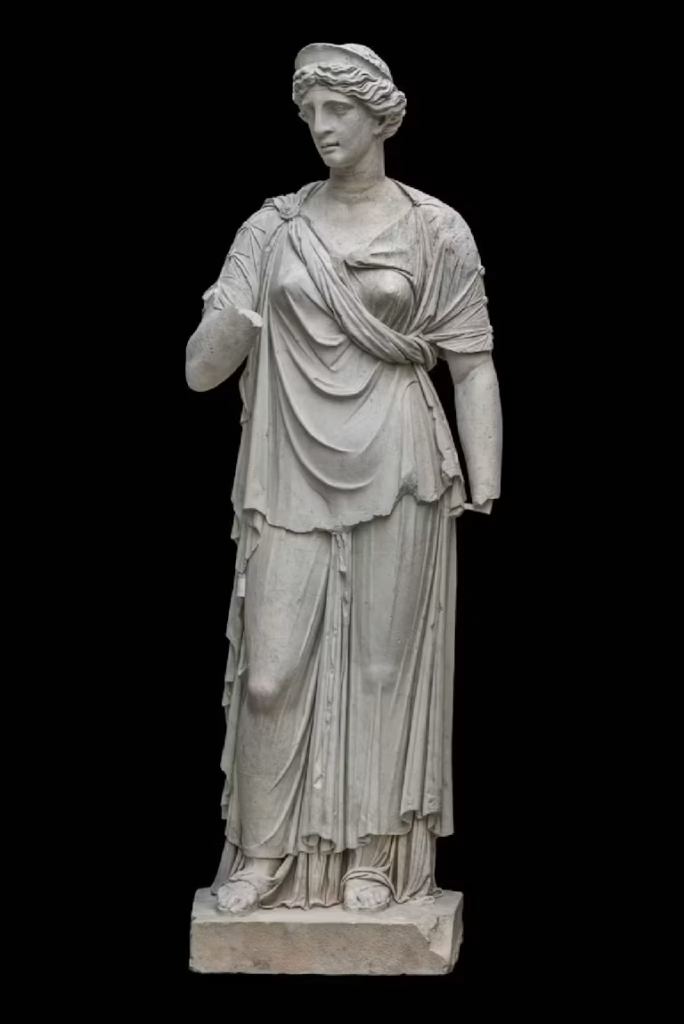
Juno was typically represented wearing a chiton tunic and cloak and sometimes with a veil over her head. She was usually depicted with a crown and holding a scepter or a patera, which is a libation bowl. She was associated with peacocks and often appeared alongside them in art.
She was also sometimes shown dressed for war with goatskin, a spear, and an octagonal shield. She wore distinctive pointed shoes and often had a snake at her feet. This reflects iconography usually associated with Athena, even though her Roman equivalent is considered Minerva.
Leave a Reply