
Greek and Roman religion is often conflated as “classical religion” because of the similarities between the Greek and Roman gods. Many people describe them as the same god, with a Greek and a Latin name. But this is an oversimplification.
The Greeks and Romans had a shared cultural heritage as Indo-European speakers, but the Greek and Roman religions developed separately. However, when the Romans encountered Greek religion, they saw the similarities between many of their gods and syncretized their native gods with Greek gods where it felt appropriate. This saw them adopt Greek mythological stories for their own gods, which influenced their character and made them “more Greek,” but they still retained unique elements that made them distinctively Roman.
Meet some of the Roman gods and understand how they differ from their Greek counterparts.
1. Jupiter vs Zeus
Jupiter was considered the most powerful of all the gods, with ultimate command over fate and the patron of Rome. He was invoked as the most important god in the Roman state religion for a millennium from the time of the legendary kings of Rome until the 3rd century AD.
Jupiter, also called Jove, was originally an Etruscan god adopted by the Latins who settled in Rome. The Italic god was a sky god associated with daylight, weather, and agriculture. It was only later that Jupiter was identified with Zeus, the king of the gods in Greek mythology, and became associated with lightning bolts. The Etruscans believed that there were 12 different types of lightning, each wielded by a different deity, not just Jupiter.

The Romans believed that it was important to act in accordance with the will of the gods. As a result, Jupiter was the god most closely associated with the auspices. He would send signs of his divine will through the flight of birds or other signs. While Zeus was sometimes associated with omens, it was a less important part of his character.
2. Juno vs Hera
Juno Regina was also an Etruscan god adopted by the Romans. As one of the most important deities of Rome, she was associated with the Greek goddess Hera, but they were very different. Hera was the goddess of marriage, women, family, and childbirth. She is mostly known in mythology for her jealous nature because her husband, Zeus, is constantly betraying her.
The Etruscan Juno was represented wearing a goatskin and carrying a spear and shield, giving her a martial aspect. She was known by the epithets Sospita, meaning savior, Lucina, meaning light of childbirth, and Moneta, a moon goddess. The Roman term for money is taken from this epithet for Juno, and the mint was in her temple.
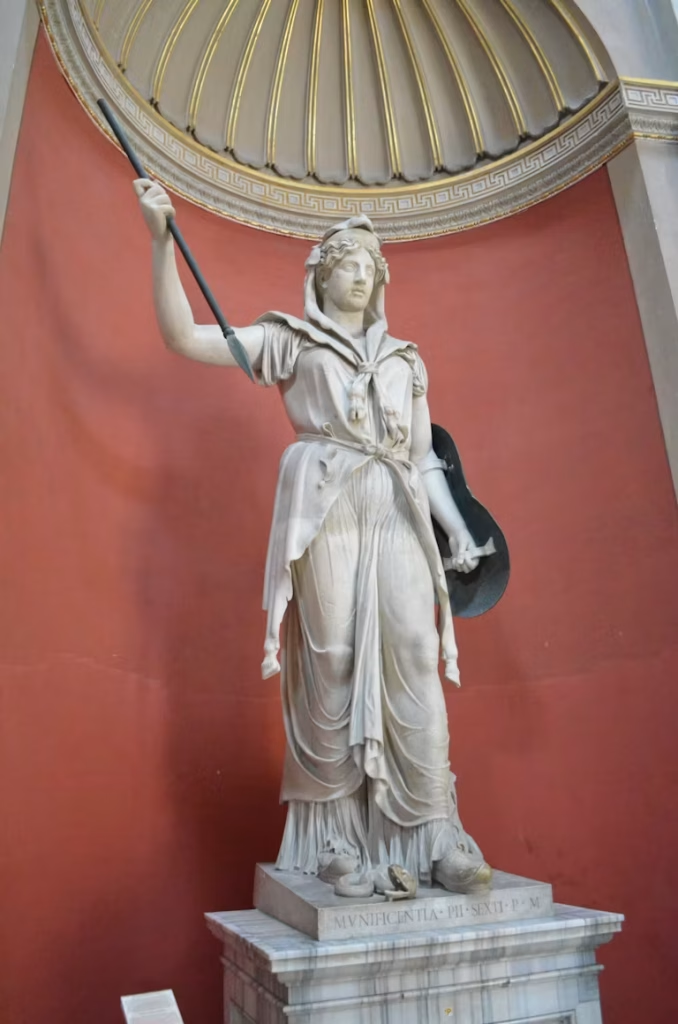
Nevertheless, Juno was also closely associated with women. She protected women in every aspect of life: when she passed from the house of her father to that of her husband through marriage, during childbirth, and in her matronly duties. Her festival, the Matronalia on March 1st, marked fertility and the start of spring.
3. Minerva vs Athena
Minerva was one of Rome’s most important goddesses and was a member of the Capitoline Triad alongside Jupiter and Juno. This triad received sacrifices in almost all Roman state rituals. She is often considered the equivalent of Athena and, therefore, considered a goddess of war, wisdom, and the arts. However, she was also originally an Etruscan goddess called Menrva. She was often depicted rushing forward with a shield decorated with an owl in one hand and a lightning bolt in the other.
While the first part of Minerva’s name, “mens,” refers to intelligence, she was principally a goddess of war, with temples dedicated to her after successful military campaigns. The major festival, the Quinquatras, was held on March 19th, the start of the campaign season.

Her association with crafts seems to have emerged only after her association with Athena. The warlike nature of Roman culture explains why they were particularly occupied with Minerva as a martial goddess.
4. Mars vs Ares
While the Roman god of war, Mars, is considered the equivalent of Ares, the two were very different. In Greek mythology, while Athena was the goddess of the strategic aspects of war, Ares was the god of its bloodier aspects. He was not widely worshipped and was not always cast in a positive light in stories from Greek mythology.
Mars, in contrast, was one of the most important gods in Rome. He was associated with both war and fertility, which was not uncommon in the ancient world. As a fertility god, there are examples of him being called on to ward off threats from nature, such as wheat fungus. Mars’ main festivals were in March, a month named for the god and marked the start of campaign season, and October, which was the end of the campaign season. Votive offerings and altar dedications to Mars made by Roman soldiers are found across the Roman Empire.

Most importantly, Mars was considered the father of Rome. According to Roman myth, Mars visited a Vestal Virgin named Rhea Silva, a princess of the city of Alba Longa, and impregnated her with twin boys, Romulus and Remus. Romulus would go on to become the founder of Rome and was deified as a divine ancestor. As a result, Mars was essential to the Roman identity.
5. Diana vs Artemis
Diana was a Roman goddess associated with wild places, the moon, and childbirth. These were characteristics she shared with the Greek goddess Artemis, and the two were syncretized. It was only after this association that Diana adopted mythological elements, such as being the twin sister of Apollo. In fact, this could not have been an original aspect of Diana, as the Romans did not have an equivalent of Apollo. He was one of the few gods imported directly from Greek mythology into Roman religion.

More so than Artemis, Diana was often conceived of as an aspect of a triple goddess. She was sometimes called Diana the huntress, Diana the Moon, and Diana of the Underworld. These goddesses were sometimes addressed separately as Diana, Luna, and Hecate, or they were all aspects of Diana as Diana Trivia, meaning triple way. Her underworld aspect seems to predate her association with Artemis. She was considered to play a role in ushering people between life and death.
6. Vesta vs Hestia
Hestia and Vesta were the goddesses of the hearth in Greek and Roman religion, respectively. While every home had a hearth that served as the focus for religious life, these were the goddesses of the collective hearth. Considering the more centralized nature of Rome, it is not surprising that Vesta was more important than her Greek counterpart.
Vesta had Latin origins, as her worship was looked after by the Vestal Virgins, Rome’s only college of female priestesses. The Romans believed that Vesta and her priestesses were imported to Rome from the Latin city of Alba Longa. While the goddess was sometimes depicted as a veiled woman, she was more often represented by her hearth fire.

Young girls were recruited to be Vestal Virgins before puberty and spent years learning their responsibilities before becoming active members of the college. Like Vesta, a virgin goddess, they were expected to remain virgins. Breaking this oath resulted in execution. However, because it was considered sacrilegious to spill the blood of a Vestal, they were placed in an underground room and left to die of starvation. This is how seriously the Romans took the cultivation of their hearth goddess.
Greek Gods in the Roman Pantheon
Some Greek gods were adopted more or less in their original form into Roman religion when the Romans embraced Greek religion around the 4th century BC.
We have already mentioned Apollo, who was a Greek import but became an extremely important Roman god. He was a god of healing, prophecy, and music. There is evidence that he had temples among the Etruscans starting in the 6th century BC, and in Rome in the 5th century BC. Augustus dedicated a temple to Apollo on the Palatine in 28 BC and adopted him as his patron deity.
Hermes was also adopted by the Romans with the name Mercury. He was a messenger god linked with boundaries, commerce, and travel, and was thought to guide souls to the underworld. Mercury may have adopted elements of native gods, such as Turms, but only to a limited extent.
Neptune was the Roman equivalent of Poseidon, the god of the sea, while Dis Pater was the equivalent of Hades, the god of the underworld, also sometimes known by both the Greeks and Romans as Pluto.
The cult of heroes was also adopted by the Romans, though they were much more popular in the Greek world. Heracles, the famous son of Zeus, was recognized as Hercules in Rome, though he did not receive sacrifices. The heroic brothers Castor and Pollux were recognized in Rome as the Dioscuri, while the healer turned god Asclepius became Aesculapius in Rome.
The Roman God Janus
One of the few unique Roman gods with no Greek equivalent, which makes him revealing about the unique aspects of Roman religion. He is the god of beginnings, endings, and transformation, and as an extension of that, gateways and crossroads. This made him the gateway to the divine, so he was invoked at the start of every religious ritual. When Julius Caesar reformed the calendar, Janus’ month, January, became the first month of the year. Janus also received sacrifices on the first of every month.
As Rome was a very martial society, Janus was also a god of war. His religious precinct in the city had gates at either end. The gates were left open when Rome was at war, and only closed when the Roman Empire considered itself at peace.

Janus is depicted with two faces, one facing in each direction, looking both into the future and the past. He was also the master of time. In another temple dedicated to the god, his statue had its fingers arranged into the number three on one hand and 65 on the other, representing the 365 days in the Roman calendar. His temple also had 12 columns to represent the months of the year.
Without a Greek equivalent, no clear mythology of Janus survives. Nevertheless, according to Macrobius, writing in the 4th century AD, Janus may have been a sun god. Paul the Deacon, writing in the 8th century AD, suggested that he was linked to the primordial waters of creation.
Leave a Reply